


Medieval Dildos
Let’s be honest, humans have always been human. This is so to say the secret motto of my “Das gemeine Wip” Instagram project.
Accordingly, in every span of human history, we can find traces of how human particularities have found their ways into every day items.
Today, I want to talk a bit more in detail about dildos in the middle ages.
There isn’t much to say about the item itself, everybody knows, what it is and what it does ;-) Archeological finds of phallus shaped items that may or may not have been used as a sex toy can already be found from the stone age, other known examples are greek and roman antiquity .
In medieval times, the amount of extant examples is less numerous and text sources are limited due to religious attitudes in christian societies.
I will list any sources known to me here in order to make a comprehensive collection of them for myself and others. I will add to this list over time in case I find other examples.
Sources:
1. Documented real cases of the use of dildos can mostly be found in judicial records, which usually means, somebody has been arrested for the use of one. The punishments in these cases are in most cases extremely harsh, the banning of the accused or even their death is usually what follows.
Lesbian relationships were in reality mostly ignored by medieval authorities, until a transgression of gender boundaries is in discussion due to the use of a dildo. Only men can penetrate, only women can be penetrated, whoever turns these ideas on their heads, endangers the fabric of medieval society.
1.1 The best known and most detailed description of a strap-on dildo comes from the judicial record of Katherina Hetzeldorfer (https://en.wikipedia.org/wiki/Katherina_Hetzeldorfer). Her case may be already familiar to you from my stories about queer people in the middle ages and definitely deserves your attention, since her case is also one of the best documented cases of a potential transgender individual from the middle ages.
In court, her (female) partners said, they had intercours with her “in the ways of a man“.
Katharina her self admitted “[…] that she did it at first with one finger, then with two, then with three and last with the wood that she held between her legs.”
and
“that she made an instrument with red leather, in the front filled with cotton and topped with wood, a hole through the wood with a tie pulled through and bound around her and that she had intercourse with the two women who are said to be her sisters.” (the weren’t her sisters, but her partners)
One of her sisters said: “she grabbed and felt that it was a big, intimidating thing, as big as half an arm. It was a horn, pointy in front and wide in the back.” and “she also says that she pees through the same thing” and “she also says that it produced so much semen, so very much, that it was more than a hand full.”
So in the end, they say hat Katharina could even urinate and ejaculate with the dildo, which frankly, I think is rather unlikely and probably a product of the fantasy of the interrogators or the interrogated under the massive pressure of the procedure.
(I translated these passages from middle high german into modern english. In case you would like to see the original text, click the links or switch to the german version of my article)
1.2 I already wrote about the case of Bertolina “Guercia” from 13th century Italy in this blogpost about another dildo reconstruction.
1.3 In Atumn 1502 in Valencia, a thief is caught. During his arrest, it turns out, he is actually a she. And she was carrying a strap on dildo (I have no idea how this arrest went about?)
“carried a thing of a man, between her legs, made of leather […] having taken a woman as if she were a man” (Citation found in “Ornamentalism: The Art of Renaissance Accessories”, page 135 oder via Academia.edu, Liza Blake )
1.4 In 16th century France, we also have the case of Mary de Vitry/Germain de Vitry who seems to have been an intersex person, who was first raised as a girl, but later lived as a man. He was sentenced to death when he was accused of using a dildo with his (female) partner/wife “Et fut pendue pour des inventions illicites à supplir au défaut de son sexe.” says Michel de Montaigne in his diary
2. An important source on sexuality in the middle ages are early and high medieval penitentiaries. These are books in which were lists of sins for priests who were taking confessions. They should work with these lists to lure sins out of the confessing people and get an orientation on what kind of penitance they should prescribe. Many of the sinners were not only normal people, but also monks and nuns.
2.1 In an 8th century penitentiary (“Penitentiary of Bede”) we find: “If nuns [fornicate] with a nun, using an instrument, seven years [penance]”
2.2 And in the penitantiary of Burchard von Worms we can also find mentions of sex toys:
“Have you done what certain women do, that is, make an instrument or object in the form of a male member, in the size which you desire, and have you fastened it to your genital area or to the genital area of another with some kind of fastening and have you fornicated with other women or have others fornicated with you in this way? If so, penance for 5 years on holy days.”
and
“Have you done what certain women do and have you fornicated with yourself with this instrument? If so, penance for one year on holy days.”
The penance mentionned usually means to live of of bread and water, abstain of any pleasures and be in prayer.
3. Other rich sources on medieval sexuality are the sermons of moral preachers, who wanted to teach everyday folk in their communities or on their travels, what they should and should not do to get to heaven:
3.1 In the 9th century Arch bishop Hinemar von Rheims, writes how lesbians have sex with each other (in his opinion). “They can not combine their genitals since nature wouldn’t allow for that, they do unnatural things by – as I heard – using certain instruments of evil function to produce lust.”
(Personally, I love the “as I heard” part to avoid suspicion :-D)
3.2 Also the german preacher Johann Geiler says in the 15th century in one of his sermons: „There are some so lustfull, that they fulfill their desires with curious instruments or with animals to execute their unchastity and insatiability.”
and
„A woman, when she abandons all shame and bumps the stool under the bench, she has been lost, there is no honour in her any more. Pfui, cursed woman, cursed whore”
4. The works of Albertus Magnus from the 13th century fall into the category of medical works. He writes: “From the age of 14, young girls often rub themselves with their fingers or other instruments”
5. The final part of our text sources is poems, myths, theatre plays and novels from the middle ages. Most of them are simply made up stories or contain ambiguous expressions and metaphores. Did the character just eat a sausage, or is this about other sausages in other openings? Sources that I take relatively serious are fore example:
5.1 Pietro Aretino – also known as the father of pornography – talks in his erotic novels in the early 16th century about Dildos, especially those made of glass, which in his stories, are filled with warm water. One may question wheither or not that is a real practice from his time or not. https://muse.jhu.edu/book/104428
5.2 A very explicit and detailed description of the use of dildos (also made from glass!) can be found in this erotic poem from the 16th century by Thomas Nashe :
“My little dilldo shall suply their kinde: A knaue, that moues as light as leaues by winde; that bendeth not, nor fouldeth anie deale, but stands as stiff as he were made of steele;”
(follow the link to the full text, it is really very entertaining)
6. Archeologically there isn’t a lot of examples of things that may have been a dildo without question.
6.1 We have extant “Joke drinking vessels” made from glass in penis shapes, of which one was hilariously found in a nuns conent in Germany. It is noteable that they look exactly like what Petro Aretino described above. But the vessels are so fragile, I wouldn’ t recommend to strain their substance through rough use.
6.2 These three objects from a medieval excavation in the 1960s in Bryggen (a trading settlement in the harbour of Bergen, Norway) I definitely had to show you in this context. They may also be decorative carving works, you can’t know, however, I would like to throw in that harbours were typical areas of sex work in the middle ages and early modern age ;-) :
Wooden penis Nr 1. from Bugarden, dated to the end of the 13th century, originally identified as a wooden peg :-D
Wooden penis Nr. 2 from Engelgarden, dated between 1200 and 1250
Wooden penis Nr. 3 from Sostergarden, dated between 1332 and 1413
Here are some elder photos of Penis Nr. 3: https://digitaltmuseum.org/0210112404741/diverse-funn-fra-utgravningene-pa-bryggen and https://digitaltmuseum.org/0210112403194/diverse-funn-fra-utgravningene-pa-bryggen and https://digitaltmuseum.org/0210112403195/diverse-funn-fra-utgravningene-pa-bryggen
And here are some more details about the finds: https://skeivekulturaar.w.uib.no/kategorier/tradisjoner/falloser/
7. You may ask yourself, what about medieval illuminations and art? That is unfortunately a difficult topic, because I do not know a single painting/illumination/relief showing women with detached phalli which can not be interpreted as an allegory/carricature/metaphor. Even if there was a picture showing a woman inserting a phallus shaped object into her vagina, it could still be a carricature making fun of the insatiable lust of women who do not care for the man attatched to the phallus.
There are plenty of examples for these kinds of pictures. Like the common motive of the Penisseller on the market (there are also several humoristic stories from the middle ages on that theme) or the well known Penistrees or the cat that steals the penis.
8. And I also need to mention that there is an extant leater dildo find, unfortunately from the 18th century.
My colleague Till Kazper reconstruced one for the history project Kaptorga.
The reconstruction
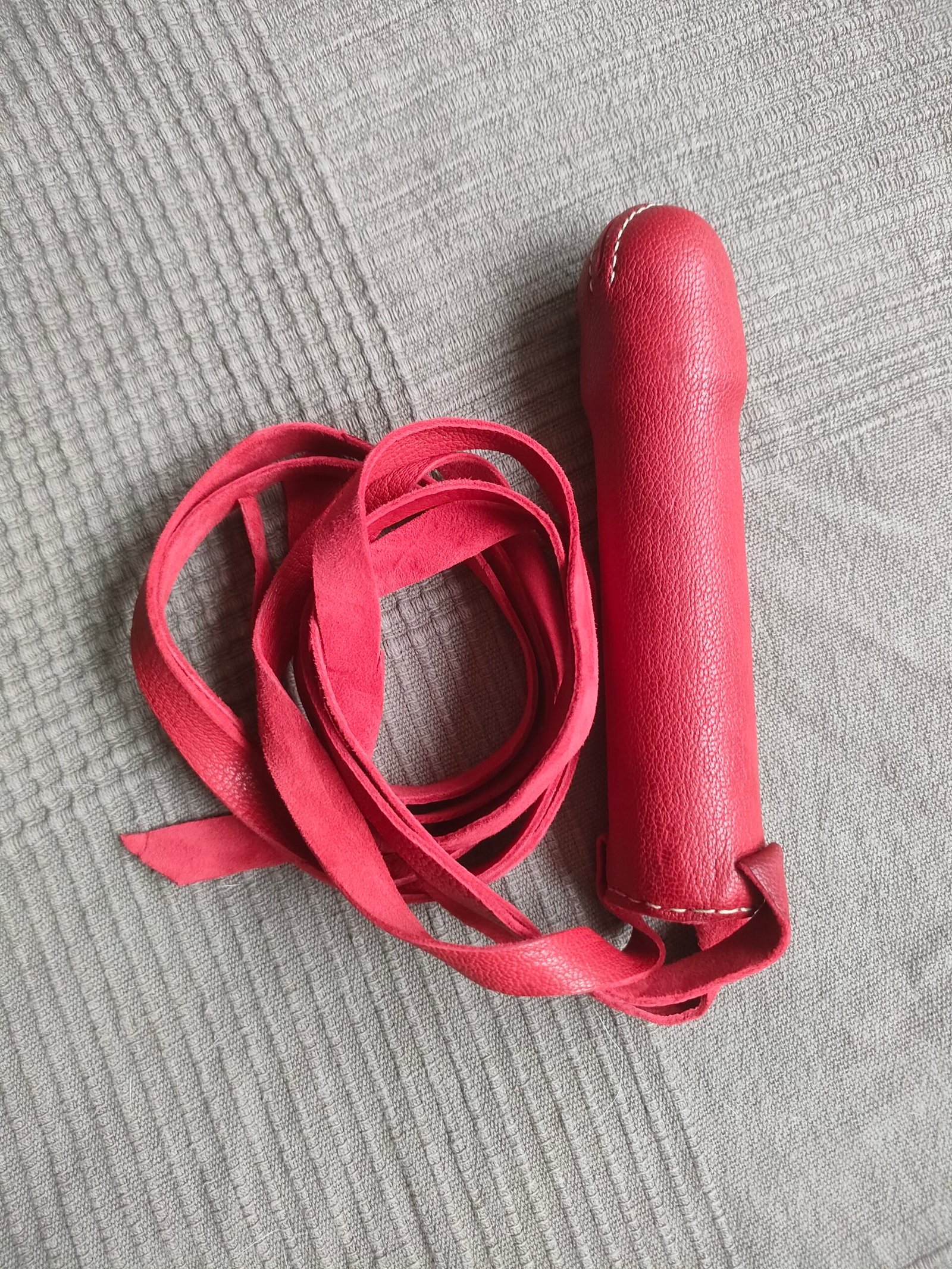
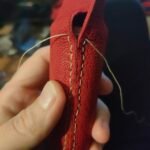
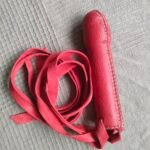
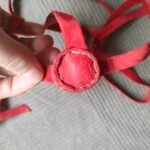
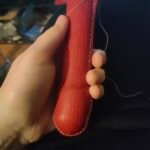
For my reconstruction attempt, I stuck closely to the description from Katharina Hetzeldorfer’s record. A wooden core with a hol in the back, a red leather cover, the tip is padded, Ribbons to tie it around the body.
My colleague Bernhard made the wooden core on his medieval wood turning bench. The original source says, the tip was padded with cotton, but cotton will very quickly bunch together and remain a hard lump, so I decided to use raw wool. I covered it with red leather an sewed it shut. I know the stitch isn’t ideala, but the leather was kind of brittle (or maybe I am too bad at leatherworking). But the seam is relatively nice and flat and I don’t think it would cause major discomfort when in use.
The ribbons can be tied around the waist and through the crotch to be tied in the back. It still wont offer the stability or comfort that modern strap ons have, but I don’t expect technical sophistication from an object that has to be made at home by whoever uses it, because buying it somewhere would have been unthinkable.


If you have any other hints and sources for me that might be interesting for this collection, let me know (info@wh1350.at), I am super interested in learning more!
Accompanying Reading list:
Female Sodomy: The Trial of Katherina Hetzeldorfer, Helmut Puff, 2000
Transgressing the Boundaries of Holiness: Sexual Deviance in the Early Medieval Penitential Handbook of Ireland, England and France 500-1000 , Christine McCann, 2010
Frühmittelalterliche Penitentiaries
Gesundheitspflege im Mittelalter; kulturgeschichtliche Studien nach Predigten des 13., 14., und 15. Jahrhunderts, Ludwig Kotelmann, 1890
https://dspace.library.uvic.ca/server/api/core/bitstreams/9ddae939-fd05-48fd-a1f1-9fd95a97e4c8/content The Rise and Fall of Seigneur Dildoe: The Figure of the Dildo in Restoration Literature and Culture, Sandra Friesen, 2005
Herteig, Asbjørn E. 1969. Kongers havn og handelssete: Fra de arkeologiske undersøkelser på Bryggen i Bergen 1955–68
Women’s Secrets: A Translation of Pseudo-Albertus Magnus’ De Secretis Mulierum with Commentaries, Helen Rodnite Lemay
Related Posts
The following posts might interest you as well: